 Cadence CRM
CRM Guide
Best CRM for Health Insurance Agents
A CRM for health insurance agents is not a fancy address book. It has to survive Open Enrollment, quote follow-up, missed calls, and next year’s renewal — without a spreadsheet on the side. This guide is what to look for in 2026, why generic sales CRMs usually fail that test, and how Cadence is built for ACA, Medicare, and private-plan agents.
What “CRM for health insurance agents” actually means
Independent health agents do not sell the same way a SaaS rep or a realtor does. A lead is not “closed” when they say yes on the phone. You still have a quote, an application, a verification call, a coverage start date, and a plan that may last three months or twelve. If your CRM cannot hold that, you will keep a second system. That second system is where enrollments get lost.
The right CRM should let you: capture the lead, follow up by email and SMS, see who is quoted vs sold, know which Facebook or referral source actually closes, and call the book when coverage is about to renew. If you are still doing that in Google Sheets plus a personal cell phone, you do not have a CRM. You have a delay.
ACA, Medicare, and private plans are not the same pipeline
ACA / Marketplace
Volume spikes around Open Enrollment. You need fast intake, a quote field, household details, deadline reminders, and drips that start the hour a lead arrives. See how to use a CRM during ACA Open Enrollment and the pre-season checklist.
Medicare Advantage and Supplement
Windows are short (AEP, OEP, SEPs). You need campaign bursts, a place to keep Scope of Appointment files on the contact, and a way to stay in touch the rest of the year. More in Best CRM for Medicare Advantage Agents.
Private, short-term, and supplemental
Terms are often 3 or 6 months, not just annual. A CRM that only thinks in “anniversary next year” will miss the people who are back in market in ninety days. Renewals have to be driven from coverage start date and term length.
Why generic CRMs and “agency OS” tools fall short
HubSpot, Salesforce, and all-in-one marketing platforms can store names. Many agencies try to force them into insurance by adding custom fields and Zapier. That works until Open Enrollment, when you needed a quote, a coverage start, a lead source close rate, and a text out the door — not another workflow to debug.
Typical gaps:
- No native quote, coverage start, household, or verification-call fields.
- SMS bolted on through a third-party number you did not set up for business use.
- Pipelines copied from “demo / proposal / closed-won,” not quote sent / app submitted / sold.
- Reporting that counts deals, not sold vs every lead from Facebook vs referrals.
- AI that writes generic emails and knows nothing about the contact’s plan or last quote.
You can customize a generic CRM. You will spend the year customizing it. A CRM built for health insurance agents should already speak that language on day one.
Features that actually matter
- Insurance contact fields: status, outcome, lead source, quote, coverage start, household, notes, tags, and files (IDs, SOAs, carrier docs) on the record.
- Email and SMS from the same workspace: templates, drips, and a business number — not copy-paste from Gmail and iMessage.
- Drip campaigns: new lead, quote follow-up, OEP deadline, post-enrollment. AI can draft the sequence; you approve it.
- Pipeline you will update: new, contacted, quoted, submitted, sold, lost — plus a close rate you can trust.
- Renewals: next due date from coverage start, including 3-, 6-, and 12-month terms.
- Lead source reporting: sold divided by all contacts from that source, not a vanity dashboard.
- Email opens and clicks: so you call people who engaged, not a blind list.
- AI that sees the contact: drafts, objection help, pipeline summary, CSV import mapping — not a chatbot on a help site.
For a practical follow-up cadence, see how to build a lead follow-up system. For why AI belongs inside the CRM, see Why AI Is Important for Your Insurance CRM.
What Cadence includes
Cadence is a web CRM for independent health insurance agents. Contacts, pipeline, email, SMS (Twilio), drip automations, calendar and follow-up reminders, renewals, reports, webinars, social posting via webhooks, and Claude AI live in one login. There is one plan: full Pro.
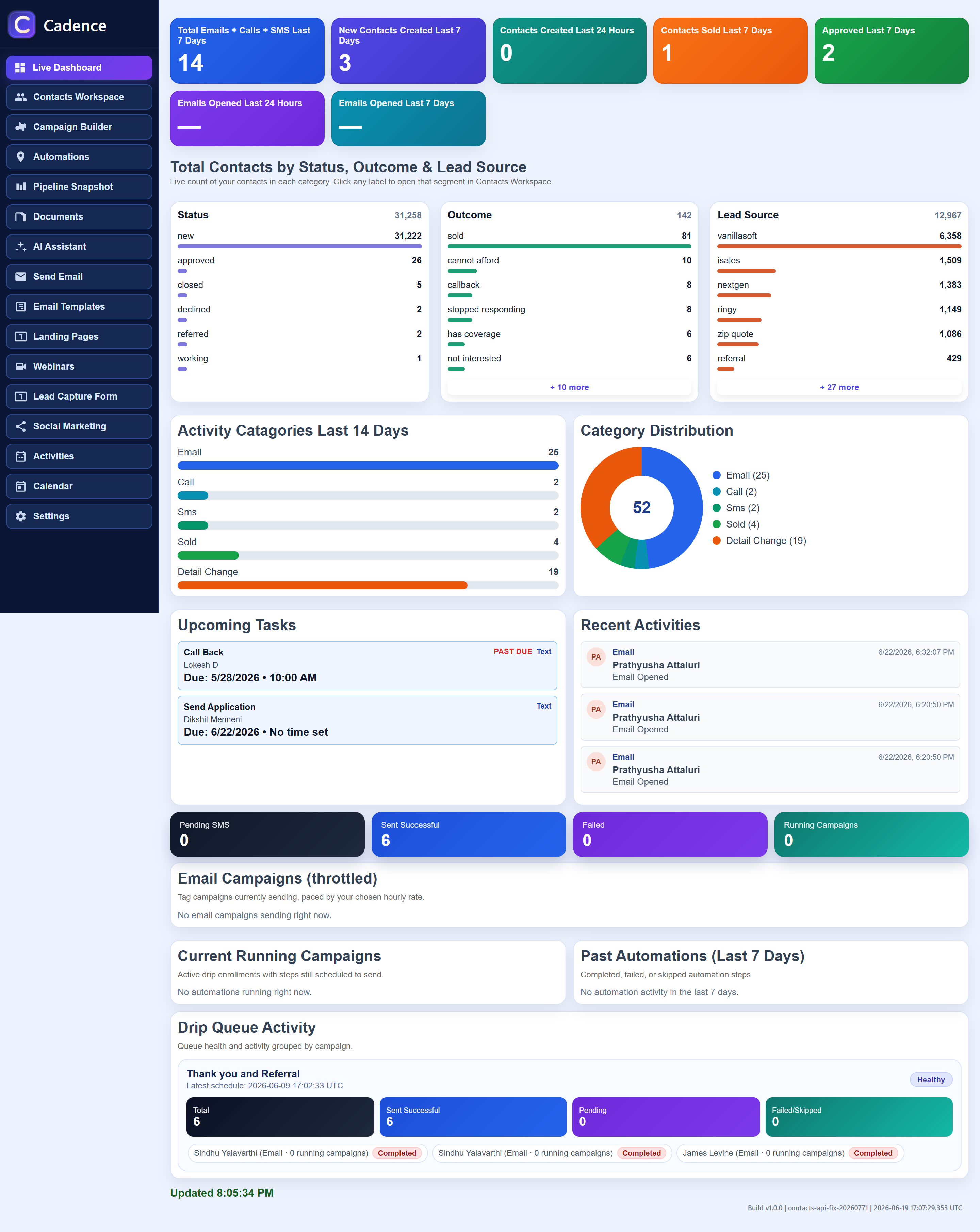
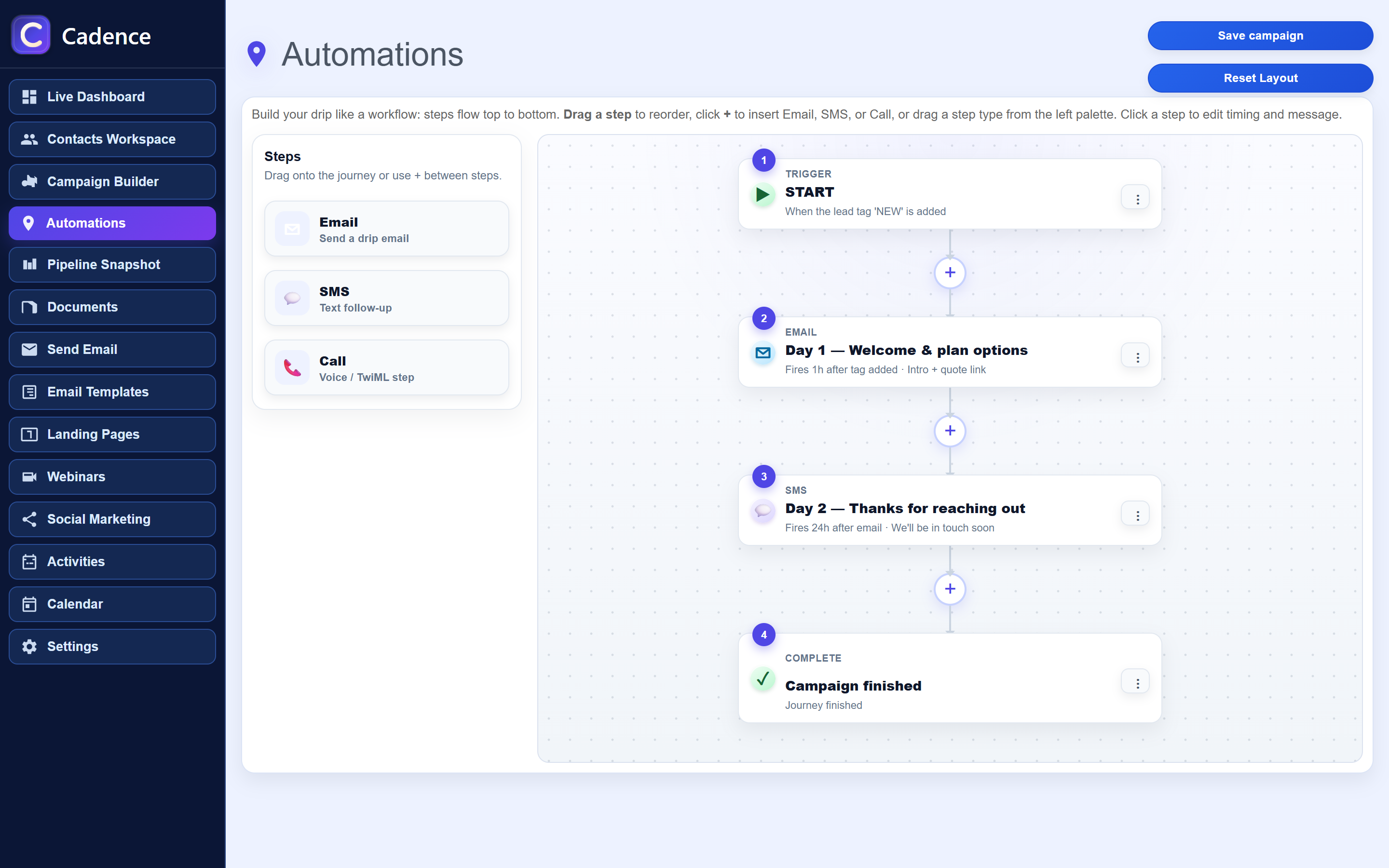
Quote and coverage dates sit on the contact. You can paste a HealthSherpa premium into Quote, set a 3 / 6 / 12 month renewal, and work a renewals list instead of a memory. Reports show close rate by lead source and email opened vs sent. AI drafts emails and texts from the contact, maps messy CSVs, and summarizes the pipeline.
Pricing
$79 per month after a 14-day free trial of the full product. No credit card on trial. No feature tiers. Cancel anytime. You bring your own email sending (SMTP) and, for SMS and voice, your Twilio account. Cadence is the system of record and the follow-up engine — not a surprise per-seat enterprise quote.
Who it is for (and who should look elsewhere)
Cadence fits solo agents and small teams who sell ACA, Medicare, and ancillary health products and want one workspace instead of five logins. It is not a P&C agency management system, not a carrier enrollment portal, and not a replacement for HealthSherpa or CMS. If you need 40-user permissions, custom Salesforce objects, or a full marketing website CMS, buy those tools. If you need to enroll households and not drop the follow-up, start here.
FAQ
What is the best CRM for health insurance agents?
One that matches quoting and enrollment, not a generic CRM with extra fields. Cadence is built for that job: contacts, pipeline, email, SMS, drips, renewals, reports, and Claude AI at $79/month after a 14-day trial.
Can I just use HubSpot or GoHighLevel?
You can. You will typically rebuild insurance fields, stages, and texting yourself. Those products serve many industries. A CRM for health insurance agents should already know quote, coverage start, lead source, and Open Enrollment follow-up.
Does Cadence handle ACA and Medicare in the same account?
Yes. Tag and stage the contact. Use drips for AEP or OEP. Store documents on the record. Track renewals from coverage start, including short-term terms.
How do I try it?
Start a 14-day trial at crmcadence.com/signup.html. Full Pro, no credit card. Import a CSV, send a test email, and run one drip before you pay.
Try the CRM built for health insurance agents
14-day free trial. Full Pro access. Then $79/month. No tiers.
Start Free Trial